

Unmatched comfort and performance.
For millennia, humans have used wool to protect themselves from the elements. Today, its performance as a fibre is still unsurpassed by anything created in a lab.
By CSIRO, CC BY 3.0, https://commons.wikimedia.org/w/index.php?curid=35488151
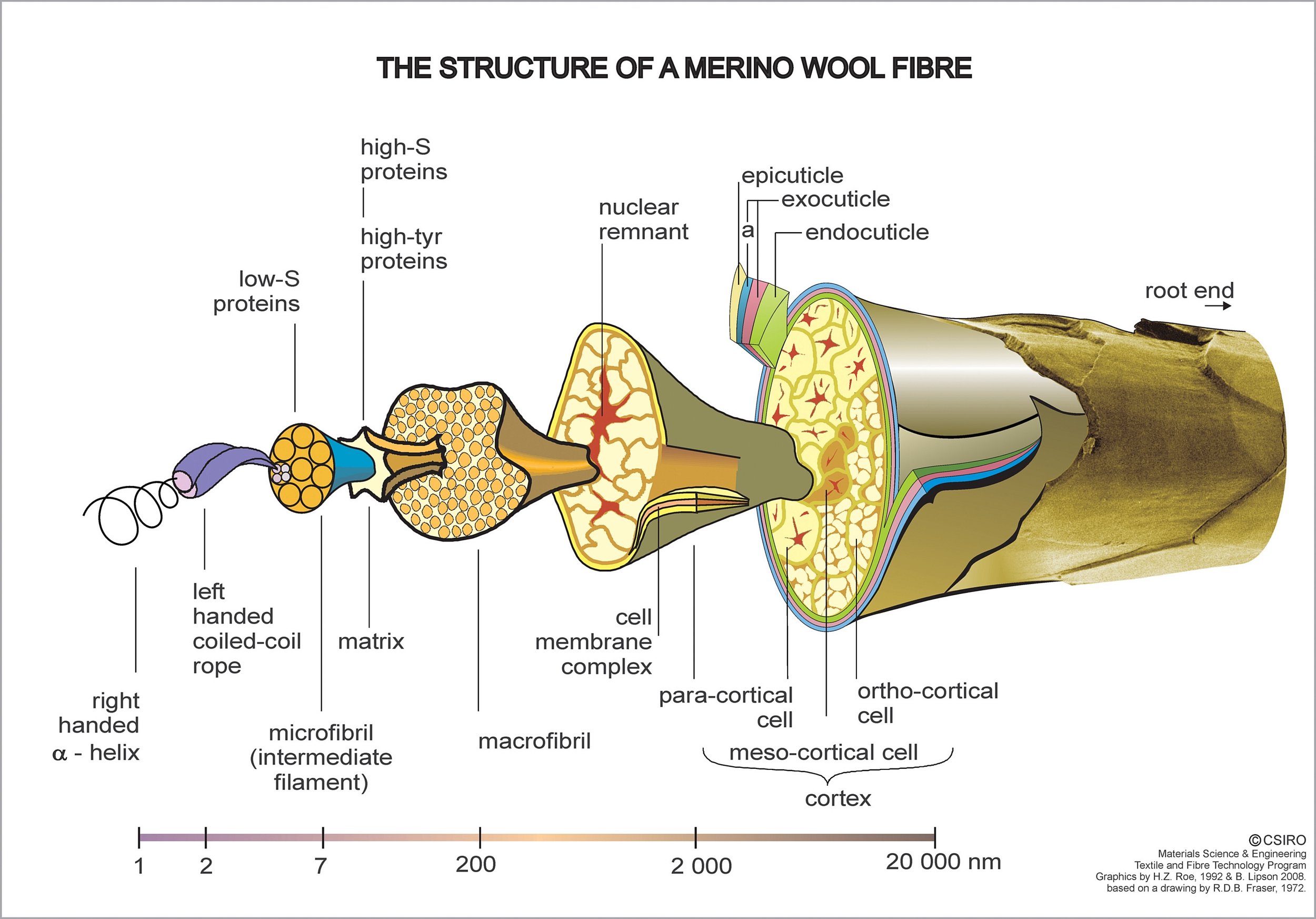
Unique helical structure
Evolved over millions of years to provide an effective natural shield from the elements, wool is stronger than steel yet finer than human hair.
Each component of a woollen fibre plays a unique role in its overall performance.
-
Deep inside each fibre lies a keratin-based protein coiled in a helical shape. This “spring” gives wool its flexibility, elasticity, and resilience.
-
Special proteins in the matrix attract water molecules, removing odour-causing vapour and locking away harmful pollutants.
-
Macro and microfibrils are long filaments that give the fibre added strength while maintaining flexibility.
-
The cortex has different-sized cells on each side which makes wool grow in a crimped and wavy fashion. This crimp makes wool feel soft and adds insulating properties because of the trapped air.
-
The waxy outside layer is known as the cuticle. It has overlapping plates or scales, which give wool the ability to repel water.
The natural benefits of wool

Thermal regulation
Wool traps air within its fibres to create a stable ‘microclimate’, making it an exceptional insulator.

Resilience and loft
A wool fibre can be bent over 20,000 times without breaking and will still return to its original shape.

Moisture regain
Wool fibres repel liquid but absorb vapour, so it never feels clammy or damp.

Flame resistance
The high keratin and moisture content of wool make it naturally resistant to burning.

Odour control
Because wool wicks moisture away, bacteria growth is inhibited making wool naturally odour resistant.

Non-allergenic
Wool fibres trap dust, spores and other allergens, removing them from the air before they can be ingested.